Venous Insufficiency: Why Your Legs Hurt and What You Can Do About It
Heavy legs at the end of the day. Aching that gets worse the longer you stand. Swollen ankles by evening. Visible veins that bulge and rope under the skin. If any of this sounds familiar, you may be living with chronic venous insufficiency — one of the most common vascular conditions in the United States, and one that is widely undertreated because too many patients assume these symptoms are simply a normal part of getting older.
They are not.
Venous insufficiency is a structural condition — and it is treatable. At Lake Area Vein Center at Sulphur Surgical Clinic, our board-certified surgeons offer the most advanced, minimally invasive vein treatments available, right here in Lake Charles, Louisiana. Patients throughout Sulphur, Lake Charles, Westlake, Vinton, DeQuincy, and across Calcasieu, Beauregard, Allen, and Cameron parishes no longer need to drive to Houston or Baton Rouge for expert vein care.
Here is what you need to know about venous insufficiency — what causes it, what it feels like, and what modern treatment actually looks like. (For a shorter overview of how we evaluate and treat it, see our varicose vein and venous insufficiency treatment page.)
What Is Venous Insufficiency?
To understand venous insufficiency, it helps to understand how healthy leg veins work. The veins in your legs have a difficult job: they must push blood upward, against gravity, back toward the heart. To accomplish this, they rely on one-way valves — tiny flaps inside the vein wall that open to let blood flow upward and then close to prevent it from flowing back down.
When those valves weaken or fail, blood pools in the lower leg instead of continuing its journey back to the heart. This backward flow is called venous reflux, and the resulting buildup of pressure in the veins is chronic venous insufficiency (CVI).
Over time, this elevated venous pressure damages the vein walls, causes the visible bulging associated with varicose veins, and leads to the symptoms that make daily life uncomfortable: pain, heaviness, swelling, and skin changes.
It is important to understand that venous insufficiency is not merely a cosmetic issue. Left untreated, CVI can progress from uncomfortable to serious — leading to skin discoloration, chronic ulcers near the ankle, and an increased risk of deep vein thrombosis (DVT).
Who Gets Venous Insufficiency?
Venous insufficiency is remarkably common — an estimated 40% of Americans have some form of venous disease. Certain factors significantly increase your risk:
- Family history — If a parent had varicose veins or venous insufficiency, your risk is substantially higher. Genetics plays a major role in valve function.
- Female sex — Women develop venous insufficiency at roughly three times the rate of men, due in part to hormonal influences on vein wall elasticity.
- Pregnancy — Increased blood volume and pressure on pelvic veins during pregnancy frequently triggers or accelerates venous disease. Many women notice varicose veins for the first time during or after pregnancy.
- Prolonged standing or sitting — Jobs that require standing for long hours — nursing, teaching, food service, manufacturing — significantly increase the load on leg vein valves over time.
- Age — Valves weaken naturally with age. CVI becomes more common after age 50.
- Excess weight — Additional abdominal weight increases pressure on the pelvic and leg veins, accelerating valve failure.
- Prior DVT — A history of deep vein thrombosis can damage valves and predispose patients to CVI.
Symptoms of Venous Insufficiency
Venous insufficiency presents across a spectrum. Some patients experience only mild discomfort and cosmetic concerns. Others have significant daily symptoms that limit activity and quality of life. Common symptoms include:
- Leg pain, aching, or cramping — Often worse after prolonged standing or sitting and better with elevation
- Heaviness or fatigue in the legs — The sensation that the legs feel like lead, especially by evening
- Swelling (edema) — Particularly in the ankles and lower legs; may leave sock-line marks or indentations in the skin
- Restless legs — An uncomfortable urge to move the legs, particularly at night
- Itching or burning over the affected vein or surrounding skin
- Visible varicose veins — Bulging, twisted, rope-like veins visible beneath the skin, typically on the thighs or calves
- Spider veins — Smaller clusters of red, blue, or purple vessels visible at the surface
- Skin changes — In more advanced disease, the skin around the ankle may become discolored (reddish-brown), hardened, or develop eczema-like changes
- Venous ulcers — Non-healing wounds near the ankle that are a hallmark of severe, long-standing CVI
If you recognize several of these symptoms, a vein evaluation is an important next step — not something to keep putting off.
How Venous Insufficiency Is Diagnosed
Diagnosing venous insufficiency begins with a clinical evaluation — a review of your symptoms, medical history, and a physical examination of the affected legs. But the definitive tool for diagnosis is venous reflux ultrasound.
Venous Reflux Ultrasound
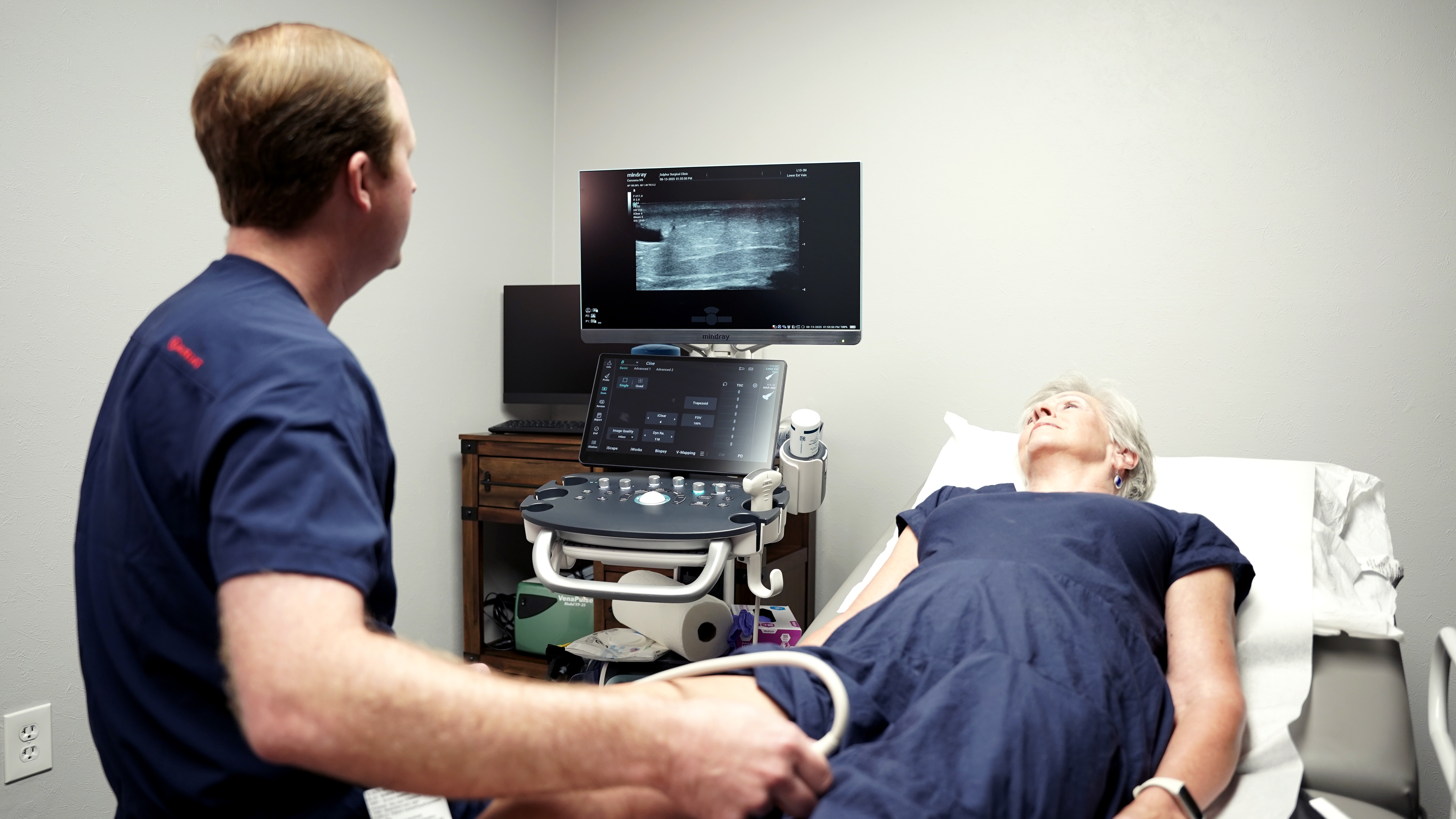
A venous reflux ultrasound is a non-invasive, painless imaging study that allows your physician to map the venous system in your legs in real time. Using high-frequency sound waves, the ultrasound visualizes the structure of your veins and — most importantly — detects the backward flow of blood (reflux) that is the hallmark of venous insufficiency.
The ultrasound identifies:
- Which veins have failing valves
- The severity and distribution of reflux
- The presence of any superficial or deep vein thrombosis
- Which veins are most likely causing your symptoms
This information is essential before any treatment is planned. At Lake Area Vein Center, we perform venous reflux ultrasound right here in Lake Charles — no travel to a separate imaging facility required.
Treatment Options for Venous Insufficiency
This is where the story for many patients changes dramatically. Venous insufficiency is not something to simply manage around — it is something to treat. Modern, minimally invasive vein procedures have transformed what treatment looks like: no hospital, no general anesthesia, no significant recovery time.
At Lake Area Vein Center at Sulphur Surgical Clinic, we offer two primary treatment modalities for venous insufficiency and varicose veins:
Endovenous Laser Treatment (EVLT)
Endovenous laser treatment — also called EVLT or endovenous laser ablation — is the gold standard minimally invasive procedure for treating the underlying cause of venous insufficiency: the diseased great saphenous vein or other incompetent trunk veins.
How it works: Under ultrasound guidance, a thin laser fiber is inserted into the affected vein through a small needle puncture — no incisions. The laser delivers precisely controlled heat along the length of the vein, causing it to close permanently. Once closed, blood naturally reroutes through healthy adjacent veins, and the treated vein is gradually absorbed by the body.
What to expect:
- Performed at Imperial Calcasieu Surgical Center — outpatient, same-day procedure
- Local anesthesia only; no general anesthesia or IV sedation
- The procedure takes approximately 45 to 60 minutes
- You walk out the same day and resume light activity immediately
- Most patients return to work within one to two days
- You go home in an ACE wrap, then wear a compression stocking from the next morning for two weeks
Results: EVLT has an excellent long-term success rate, with studies showing closure rates above 95% at one year and sustained relief of symptoms in the large majority of treated patients.
Varithena Foam Injection
Varithena is an FDA-approved injectable foam specifically formulated to treat varicose veins and venous insufficiency. It is an ideal option for patients with a broader distribution of varicose veins or for those whose anatomy makes EVLT less suitable.
How it works: A small amount of Varithena foam is injected directly into the diseased vein through one or two needle sticks. The foam displaces the blood inside the vein and causes the vein wall to contract and close. Like EVLT, the treated vein is absorbed by the body over time while blood reroutes through healthy veins.
What to expect:
- No incisions — typically just one to two needle sticks
- Performed entirely in our Lake Charles office under ultrasound guidance
- The procedure takes under one hour
- Minimal discomfort; no anesthesia required
- Patients walk out of the office immediately and can resume light activity the same day
- You go home in an ACE wrap, then wear a compression stocking from the next morning for two weeks
Results: Varithena provides rapid, visible improvement — many patients notice a reduction in bulging veins within days to weeks. Clinical studies demonstrate significant improvement in symptoms and quality of life with a single treatment session in many patients.
Conservative Management
Before or alongside procedural treatment, conservative measures can reduce symptoms and slow disease progression:
- Graduated compression stockings — The cornerstone of conservative venous disease management. Properly fitted compression stockings reduce venous pressure, improve blood return, and relieve symptoms of aching and swelling. Most insurance plans require a trial of compression therapy before authorizing procedural treatment.
- Leg elevation — Elevating the legs above heart level for 30 minutes, several times daily, reduces venous pressure and swelling.
- Regular walking — Calf muscle contraction during walking is one of the most powerful pumping mechanisms for venous return. Regular walking significantly benefits patients with CVI.
- Weight management — Reducing abdominal pressure on the pelvic veins reduces the load on leg vein valves.
Conservative management helps symptoms but does not repair damaged valves. For patients with significant reflux, procedural treatment is the only way to address the root cause.
Does Insurance Cover Venous Insufficiency Treatment?
For many patients, yes — treatment for symptomatic venous insufficiency is covered by Medicare, Medicaid, and most commercial insurance plans when the following conditions are met:
- You have documented symptoms of venous insufficiency (pain, swelling, skin changes)
- Venous reflux has been confirmed on ultrasound
- You have completed a trial of conservative therapy (typically six to twelve weeks of compression stockings) without adequate relief
At Lake Area Vein Center, we work with our patients to navigate insurance prior authorization and ensure that every eligible patient gets the coverage they deserve. We also accept CareCredit financing for patients with out-of-pocket costs or those pursuing cosmetic vein treatments.
Why Choose Lake Area Vein Center at Sulphur Surgical Clinic?
Patients throughout Southwest Louisiana no longer have to drive to Houston or Baton Rouge for expert vein care. Lake Area Vein Center brings expert, physician-led vein treatment to Lake Charles — close to home, far from the impersonal experience of a large corporate vein chain.
Board-certified surgeons with deep local roots. Dr. Devin Seale, Dr. Stephen Castleberry, and Dr. Matthew Ayo are all board-certified general surgeons backed by the 50-plus-year reputation of Sulphur Surgical Clinic. Dr. Seale and Dr. Castleberry are Sulphur natives — this is not a national franchise staffing a local clinic, these are your neighbors practicing in the community where they grew up.
Advanced minimally invasive treatments. EVLT and Varithena represent the current standard of care for venous insufficiency. Many patients in this region are still being told to simply “live with it” or are offered treatments that are outdated or inadequate. Lake Area Vein Center brings state-of-the-art vein care to Southwest Louisiana.
In-office diagnosis and treatment planning. We perform venous reflux ultrasound in our Lake Charles office, with your surgeon reviewing the full study and walking you through findings and treatment options at a follow-up clinic visit about a week later. No referrals to outside imaging centers, no inter-facility records transfer.
No referral required. You do not need a referral from your primary care physician to schedule a vein consultation at Lake Area Vein Center. Call us directly and we will get you in.
CareCredit accepted. For patients with out-of-pocket costs, we offer CareCredit financing so that cost is not a barrier to getting care.
Frequently Asked Questions
Are varicose veins dangerous? In most cases, varicose veins are not immediately dangerous, but they are a sign of underlying venous insufficiency that can progress over time. Untreated CVI can lead to skin changes, venous ulcers, superficial thrombophlebitis, and an increased risk of DVT. It is worth having an evaluation rather than watching and waiting indefinitely.
Is vein treatment painful? Both EVLT and Varithena are performed with local anesthesia and are well-tolerated by patients. Most describe the procedures as mildly uncomfortable at most. Post-procedure soreness is common for a few days and is easily managed with over-the-counter pain medication and compression.
How long does treatment take? Both EVLT and Varithena are same-day procedures taking 45 to 60 minutes — Varithena is performed in our Lake Charles office, and EVLT at Imperial Calcasieu Surgical Center. Most patients drive themselves home and resume light activities the same day.
Will my varicose veins come back after treatment? Treated veins do not come back. However, venous insufficiency is a chronic condition — new veins can develop reflux over time, particularly if underlying risk factors (prolonged standing, weight) are not addressed. Many patients benefit from periodic follow-up and, in some cases, additional treatment sessions for new varicosities.
Do I need to wear compression stockings after treatment? Yes. You go home in an ACE wrap, switch to a compression stocking the next morning (post-procedure day 1), and wear compression for two weeks after either EVLT or Varithena. Compression stockings optimize healing, reduce bruising, and improve outcomes after both procedures. About one to two weeks after the procedure, a follow-up DVT ultrasound checks the deep veins for blood clots.
Do I need a referral to be seen at Lake Area Vein Center? No. You can call Lake Area Vein Center at Sulphur Surgical Clinic directly at (337) 425-9300 to schedule your vein consultation. We also welcome referrals from primary care physicians, OB/GYNs, and other specialists throughout Calcasieu, Beauregard, Allen, and Cameron parishes.
How do I know if my symptoms are caused by venous insufficiency? The best way to find out is a venous reflux ultrasound. Many patients are surprised to learn that leg pain, heaviness, and swelling they attributed to “just getting older” are actually the result of treatable venous disease. A consultation with one of our surgeons at Lake Area Vein Center is the first step toward exactly this evaluation, and the ultrasound is scheduled as its own appointment.
Stop Living With Leg Pain — Schedule Your Vein Consultation
You do not have to drive to Houston or Baton Rouge for expert vein care, and you do not have to keep managing symptoms that have a real solution.
Lake Area Vein Center at Sulphur Surgical Clinic serves patients throughout Sulphur, Lake Charles, Westlake, Vinton, DeQuincy, and across Southwest Louisiana — with board-certified surgeons whose roots in this community run generations deep.
Call (337) 425-9300 to schedule your vein consultation today. No referral required.
Expert vein care, rooted in this community — right here at home.
Our offices:
- Lake Area Vein Center — Lake Charles office · 1920 W Sale Rd, Suite 5, Lake Charles, LA · (337) 425-9300
- Sulphur Surgical Clinic · 914 Cypress St, Sulphur, LA 70663 · (337) 527-6363
Ready to map what's going on with your veins?
Every patient starts with a consultation and exam with one of our surgeons; the mapping ultrasound is its own appointment. Call our front desk and we'll get you on the schedule.